When Does Data Value Reduce to Class Balance?
A Coverage View of Per-Point Data Valuation
School of Computer Science, The University of Sydney
Video
3:49 · subtitles in the video · narrated by a synthetic voice (Kokoro-82M)
The rule in one glance
Abstract
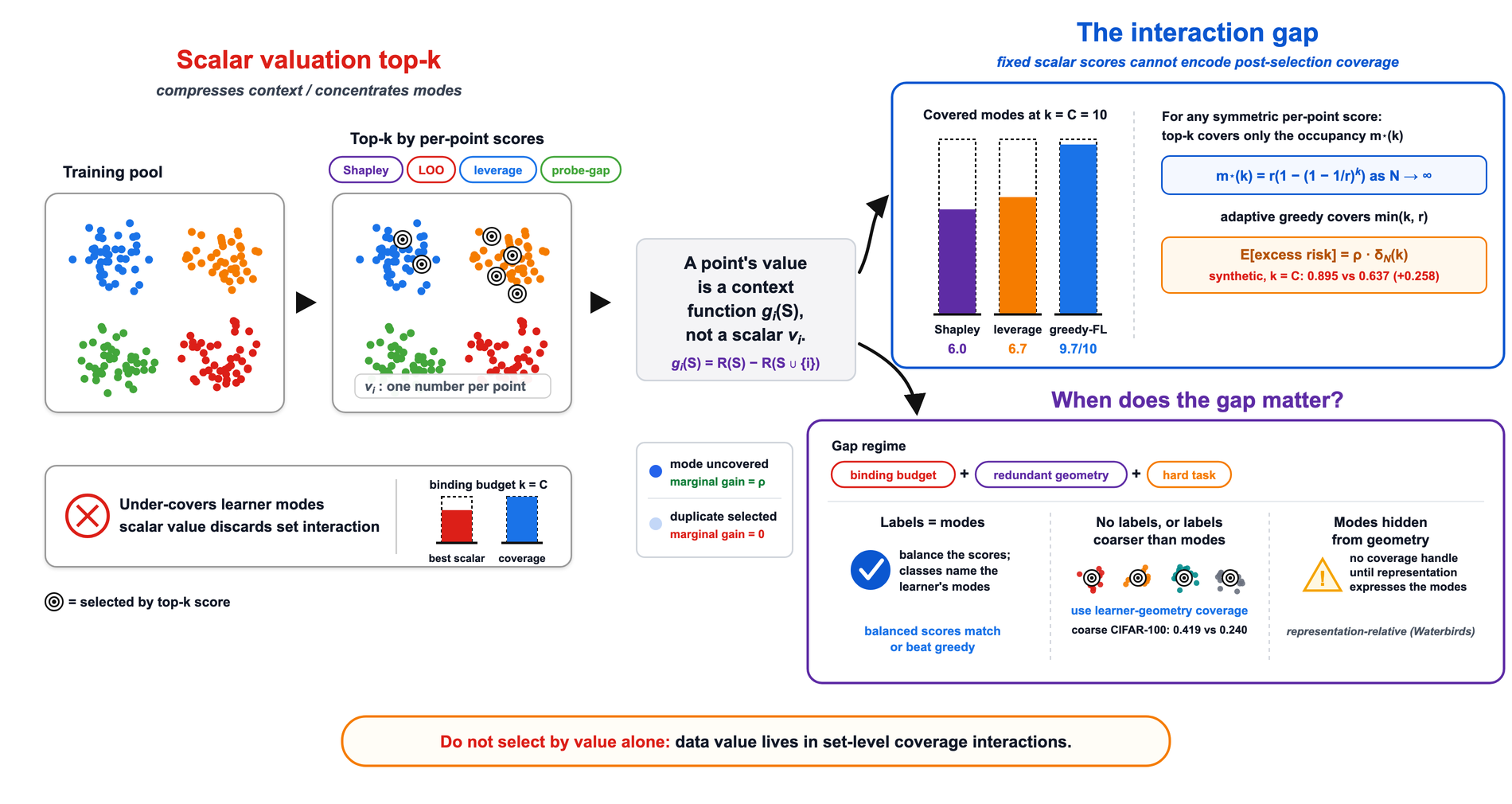
Per-point data-valuation scores — Data Shapley, influence, leverage — are routinely used to select training data: keep the points with the top k scores. We argue that top-k by a fixed, mode-blind per-point score is the wrong selection rule precisely in the regime where data selection matters. The reason is that a point's value is not a fixed number but depends on what else has been selected — a near-duplicate of an already-chosen point adds almost nothing, however high its score — and a per-point scalar cannot express this interaction.
The theory quantifies this failure exactly: in an equal latent-mode model, fixed top-k selection incurs a closed-form excess risk over adaptive coverage because it repeatedly spends budget on already-covered modes. The gap is largest when the budget is tight, the learner representation is redundant, and missing a mode is costly.
The practical rule is simple: use balance when the labels available at selection identify the learner's modes, and use explicit coverage when they do not. On standard classification tasks with strong pretrained features, class-balancing the same per-point scores recovers the missing coverage and matches or outperforms generic set coverage across our datasets. Without labels, label-free coverage improves accuracy by up to +0.20 while raw top-k can fall below random; when labels are coarser than the modes, coverage within coarse strata performs best. We turn this distinction into a pre-specified diagnostic and validate it across both favorable and stress-test settings.
The limits are part of the claim: the advantage is representation-relative. Coverage fails when the relevant modes are not expressed in the learner geometry, as with spurious subgroups, or when data quality varies independently of coverage — exactly as the theory predicts.
Overview
Citation
@article{bai2026when,
  title   = {When Does Data Value Reduce to Class Balance? A Coverage View of Per-Point Data Valuation},
  author  = {Yingjie Bai and Weiming Zhi},
  journal = {Transactions on Machine Learning Research},
  issn    = {2835-8856},
  year    = {2026},
  url     = {https://openreview.net/forum?id=AZExWUZRPd}
}